



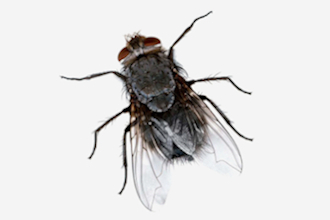
The housefly (Musca domestica) is an insect of diptera order and belongs to Muscidae family. In Europe the genus Musca is represented by twelve species. In Greece, apart from houseflies, we find Musca autumnalis, Musca larvipara, Musca Osiris, Musca tempestiva. In the Cyclades, the Dodecanese and Cyprus encounter Musca crassirostris and in Cyprus Musca sorbens, but not endemic. The species Musca domestica are represented in Europe by two subspecies. In Greece the housefly is Musca domestica domestica.
The adult housefly can reproduce with ease due to its ability to lay their eggs inside any biological material that decomposes and the speed at which larvae grow and become adults (capable of reproducing: 10 days). Its life expectancy, under propitious nutritional and environmental conditions, is 8-10 days in which it can be laid about 1000 eggs (150-200 at a time every 3-4 days).
Adult houseflies use their proboscis to feed. Solid foods are sprinkled on with saliva in order to dissolve and then sucked through proboscis. Although they are domestic flies, usually confined in humanmade environments, these can fly long distances away from their native place. They are activated mainly during daytime, while at night they rest on corners of the rooms or ceilings.
Houseflies larvae are about 9,5 to 19,1 mm long. Their structure development is classified into three stages. At first stage the larvae are 2-5 mm long, at second stage 6-14mm long and at third stage 15-20mm long. These stages are achieved in about 2-3 days for the first case, 3-4 days for the second and 4-6 days for the third.
In colder climates, flies only survive coexisting with humans. They tend to assemble groups and it is difficult to catch them. They may carry over 100 pathogens related to typhus, cholera, salmonella, syngellosis, carbon, eye infections and endoparasitic worms. In poorer countries lacking sanitation, flies are considered as the most common disease carrier. Some strains have developed resistance to common insecticides.
Except from solid organic material that houseflies process with saliva or vomiting, they can also feed on liquids or semi-liquids. The fact that houseflies leave their poop almost continuously (as they consume large amount of food) render them dangerous.