



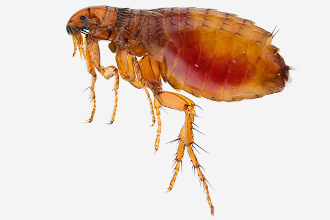
Flea is the most common name of flightless insects, belonging to Siphonaptera order. Some scientists use the older term Aphaniptera. These are external parasites living by feeding on the blood of mammals and birds. Given that they transmit diseases, fleas are very dangerous.
The length of insects ranging from 1,5 to 3,3 mm. They are typically brown. They have short antennae on their head and blood-sucking mechanism into mouth. Their body is side pressed to allow animals move around the fur or their victim’s feathers (or under the clothes) and the back consists of eight thoracic rings. Their legs are long, with the back being larger than the front leg, allowing the flightless insects to make long jumps and body tilt forward. Fleas can also launch themselves up to 200 times their body length, ranking them among the best jumpers (compared to their size). Another distinctive characteristic is their body hardness that withstands pressure like scratching. It is glossy and covered with many hairs and short spines directed backward, which also assist its movements on the host.
The female flea lays very small, white eggs in places with dust and no light. In that place eggs are hatched, and larvae emerge. Then larvae form their cocoon and transform into adults. They do not have eyes, but their mouth has developed organs allowing them to chew. Although adult fleas exclusively feed on blood, the larvae feed on any available organic material such as faeces, dead insects etc.
The most common species of fleas are the following:
- Cat flea (Ctenocephalides felis)
- Dog flea (Ctenocephalides canis)
- Human flea (Pulex irritans)
- Northern rat flea (Nosopsyllus fasciatus)
- Oriental rat flea (Xenopsylla cheopis)
Fleas bites can certainly be an itchy annoyance and dangerous, as fleas are intermediate hosts for many parasites and facilitate epidemic spreading.