



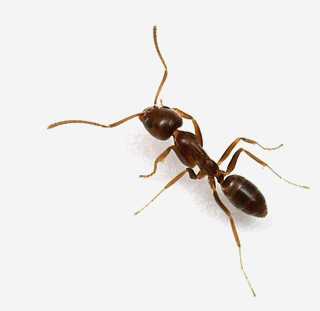
Ants are social insects of the family Formicidae and, along with the related wasps and bees, belong to the order Hymenoptera. Ants evolved from wasp-like ancestors in the Cretaceous period, about 110-130 million years ago, and diversified after the rise of flowering plants. More than 12,500 of an estimated total of 22,000 species have been classified. They are easily identified by their elbowed antennae and the distinctive node-like structure that forms their slender waists.
Ants form colonies that range in size from a few dozen predatory individuals living in small natural cavities to highly organized colonies that may occupy large territories and consist of millions of individuals. Larger colonies consist of various castes of sterile, wingless females, most of which are workers, as well as soldiers, and other specialized groups. Nearly all ant colonies have some fertile males called "drones" (aner) and one or more fertile females called "queens". The colonies are described as superorganisms because the ants operate as a unified entity, collectively working together to support the colony.
Ants have colonized almost every landmass on Earth. The only places lacking indigenous ants are Antarctica and a few remote or inhospitable islands. Ants thrive in most ecosystems and may form 15–25% of the terrestrial animal biomass. Their success in so many environments has been attributed to their social organization and their ability to modify habitats, tap resources, and defend themselves. Their long co-evolution with other species has led to mimetic, commensal, parasitic, and mutualistic relationships
Ant societies have division of labor, communication between individuals, and an ability to solve complex problems. Ant life starts from an egg. If the egg is fertilized, the ant will be female. If not, it will be male. Ants undergo complete metamorphosis with the larva stages passing through a sequence of stages: egg, larva, pupa, adults. The larva is largely immobile and is fed and cared for by workers. Food is given to the larvae by trophallaxis. This is also how adults share food, stored in the "social stomach". Larvae may also be provided by solid food, such as trophic eggs (eggs serve as food), pieces of prey, and seeds brought by experienced workers. In some species, larvae are moved straight up on prey to feed.
Larvae undergo an extensive transformation to finally enter the pupal stage. The larvae have free extensions and not fused and attached to their body as butterfly larvae. Most ants are predators, carnivores and indirect herbivores, while other species have developed some specialized ways of securing food. Leafcutter ants (Atta and Acromyrmex) feed exclusively on a fungus that grows only within their colonies. They continually collect leaves which are taken to the colony, cut into tiny pieces and placed in fungal gardens. Workers specialize in related tasks according to their sizes. The largest ants cut stalks, smaller workers chew the leaves and the smallest tend the fungus.
The mid-leafcutter ants of Atta cephalotes have quite sharp jaws, however, as they constantly cut large amounts of leaves, their blades bite. When this happens and for the rest of their lives, they undertake leaves cutting and food transportation to the nest.
Leafcutter ants are sensitive enough to recognize the reaction of the fungus to different plant material, apparently detecting chemical signals from the fungus. If a leaf type is found to be toxic to the fungus, the colony will no longer collect it. The ants feed on structures produced by the fungi called gongylidia. Symbiotic bacteria on the exterior surface of the ants produce antibiotics that kill bacteria introduced into the nest that may harm the fungi.